Home > Intro to BSV blockchain > Blockchain Technology in Agriculture
The Role of Blockchain in Agriculture
Agriculture runs on trust between farmers, buyers, suppliers, and consumers. But when data is scattered, payments are delayed, and product origins aren’t clear, that trust is hard to maintain.
Blockchain brings everyone onto the same page. It creates a single, verifiable record of what’s grown, how it’s processed, and where it’s sold. From land registration to harvest tracking and carbon reporting, blockchain helps the entire food ecosystem work more smoothly.
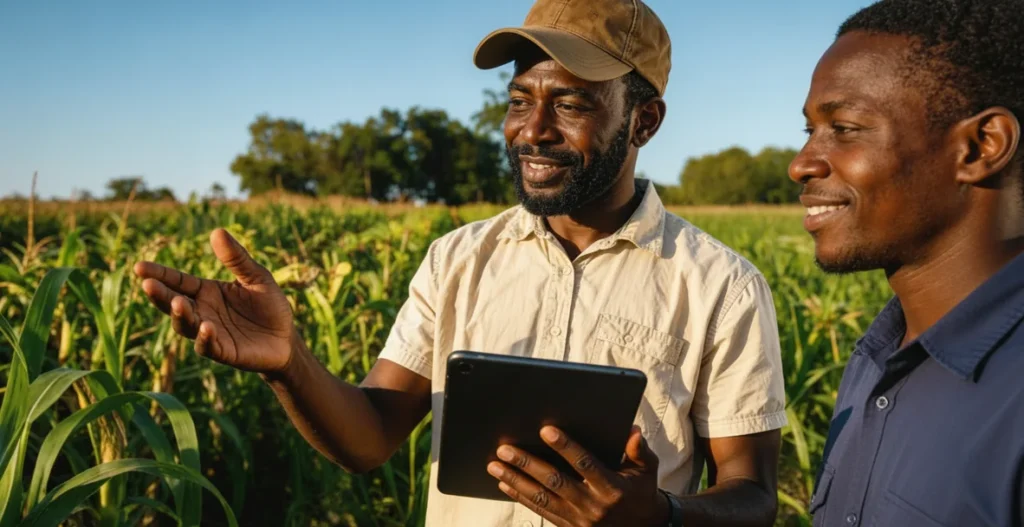
How Blockchain Is Transforming the Agriculture Industry
Agriculture is embracing technology faster than ever but digital tools only work when everyone can trust the data they share. Blockchain builds that trust. It connects farmers, cooperatives, governments, and buyers through a transparent network that records every step of the agricultural process.
From preventing counterfeit seeds to proving sustainability claims, blockchain is quietly modernising farming without disrupting what already works.
Challenges
Agriculture Challenges
Farming has always been about balancing risk, weather, markets and now, data. But across the agricultural sector, four persistent challenges continue to slow progress and limit trust between farmers, buyers, and regulators.
Fragmented and Unreliable Data
Most farmers manage information across multiple platforms: government databases, co-operative systems, and spreadsheets that don’t talk to each other. This means conflicting crop records, uncertain ownership data, and long waits for verification when applying for insurance, subsidies, or export certification.
Without a shared source of truth, it’s easy for small discrepancies to turn into costly disputes.
Counterfeit Inputs and Product Fraud
Fake seeds, diluted fertilizers, and mislabelled produce are a hidden tax on agriculture, lowering yields and damaging trust between suppliers and farmers. Even small-scale counterfeiting can ripple through a food system, affecting both livelihoods and food safety.
Slow and Uncertain Payments
Cash flow can make or break a farming season. Yet many farmers wait months for payments, whether from government subsidy schemes, export buyers, or crop insurance providers. Manual paperwork, inconsistent data, and banking delays create frustration and financial strain, especially for smallholders.
Unverified Sustainability Data
From carbon emissions to water use, agriculture sits at the centre of the global sustainability conversation. But verifying those metrics is still difficult. Too often, sustainability reporting depends on self-declared data or paper-based audits that are expensive and hard to validate.
Solutions
Blockchain Solutions
Data Transparency
Accurate data is the foundation of good farming decisions. Yet agricultural data is often scattered between co-ops, ministries, insurers, and buyers, leading to duplication, disputes, and delays.
Blockchain unifies this information in one secure ledger, giving every stakeholder a clear, consistent view of land titles, crop yields, and transactions. At the same time, you can ensure that only approved parties can see sensitive data, preserving privacy and confidentiality.
In India, for example, false crop insurance claims have prompted investigations and blacklisting of farmers an issue that traceable, tamper-proof data could prevent entirely.
The result: cleaner records, faster access to credit and subsidies, and stronger confidence in agricultural data.
Supply Chain Integrity
Fake seeds and fertilizers don’t just reduce yields, they erode trust in the entire agricultural supply chain.
Blockchain serves as the underlying infrastructure for digital product passports, enabling secure, end-to-end tracking of inputs from farm to manufacturer and supporting fast, accurate recalls.
The result: trusted products, safer crops, and improved food security.
Finance
For many farmers, access to finance is slow, complex and unpredictable. Loan disbursements, subsidies and insurance claims often face delays and lack transparency.
Blockchain technology can change this by reducing information asymmetry and fraud, and the ability to accelerate payments once predefined milestones are met. In this way, farmers gain faster, more reliable access to capital, insurers or funders gain greater confidence, and intermediaries are reduced.
It ensures money moves directly and fairly between governments, banks, and farmers, without middlemen or confusion.
The result: faster payouts, reduced fraud, and better financial inclusion in rural communities.
Sustainability
Agriculture is under growing pressure to prove its environmental impact. But sustainability data from emissions to soil health is often incomplete or unverifiable. Blockchain changes that by providing auditable, tamper-proof records of farming practices, resource use, and carbon capture.
It enables farmers to demonstrate compliance, access carbon credit markets, and prove that their sustainability claims are real.
The result: measurable accountability, stronger environmental credentials, and fair rewards for sustainable farming.
Visit our use cases of blockchain being adopted in Agriculture.