
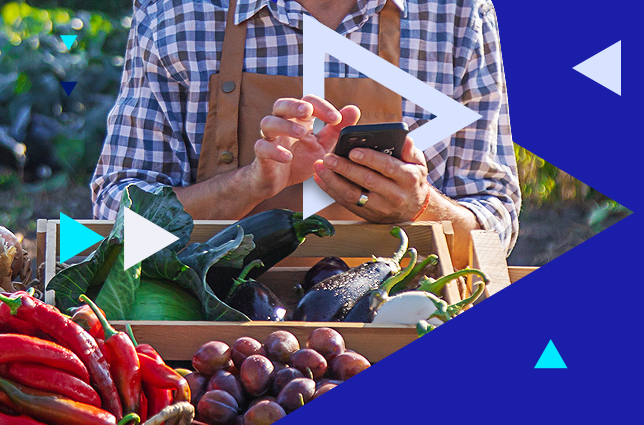
Local food systems are fragmented and largely invisible. Farmers hand sensitive data to platforms that aggregate it without attribution, restrict access and sell it back at a premium. Knowledge flows through paid intermediaries rather than directly between producers, and trust erodes as a result. Against this backdrop, the global regenerative agriculture market is projected to reach USD 5.77 billion by 2034, growing at a compound annual growth rate of 15.97%.
The data reflects the scale of the problem:
Four distinct but interconnected problems sit at the root of this breakdown:
Mycelia is a location-aware community platform built on BSV blockchain, connecting farmers, community organisers and consumers around shared work and place. Rather than extracting attention, it functions as empowering social infrastructure for the food system. At its core is the Mycelia Wallet, built on the BRC-100 standard, which allows participants to register once and access every connected application through a single self-sovereign identity no passwords, no repeated onboarding. Farmers can share verified data records including soil test results, nutrient levels, Brix readings, water quality data and growing practices, with every record timestamped, attributed and owned by the producer.
Users can post offers and requests, run events and form guilds all tied to real-world locations.
Mycelia operate as an identity overlay across the regenerative agriculture tool ecosystem spanning farmOS, OpenTEAM, design games and marketplaces aggregated into a user-owned personal toolkit.
Producers retain full control over what is shared, with whom and on what terms. Large files are stored off-chain with cryptographic hashes anchored on-chain to ensure immutability and attribution.
The BRC-100 standard ensures portability across the wider regenerative agriculture tool ecosystem. The architecture is validated as a common identity overlay deployable across multiple platforms and geographies.
Wallet infrastructure was deployed as the foundation layer, enabling identity-first onboarding. BRIXit was then launched as the first application running on the Mycelia identity layer.
Early users were onboarded to claim their sovereign identity and access connected tools. Blockchain complexity is deliberately abstracted from the end-user experience to keep participation accessible.
Thousands of users are targeted for onboarding, with each claiming their Mycelia identity and gaining access to BRIXit, the first of multiple ecosystem applications running on the shared identity layer. The architecture has been validated as a deployable common identity overlay across multiple regenerative agriculture ecosystems, establishing the foundation for a universal sign-in layer across the regen-ag tool ecosystem a decentralised alternative to big tech social infrastructure.
Structurally, cooperation barriers between producers, platforms and communities have been reduced by making contributions transparent and attributable from day one, demonstrating a practical model for how food systems can shift from fragmented, extractive structures to trusted, collaborative networks.
Looking ahead, Mycelia aims to expand its identity layer to connect a broader range of regen-ag tools, marketplaces and data platforms, while building out dashboards that aggregate the full ecosystem into a single user-owned interface for personal sense-making. Verified data sharing will be scaled to support policy, procurement and investment decisions across the regenerative food sector, with Mycelia positioned as a replicable model for community-owned digital infrastructure across adjacent sectors.


Blockchain is a distributed digital ledger that securely records transactions across multiple computers. This ensures transparency and prevents fraud. Once verified, data cannot be altered, making it ideal for sectors like finance, healthcare, and manufacturing. The BSV blockchain further builds on this by offering fast, scalable transactions while enabling smart contracts, secure transfers and immutable records – all with a low environmental footprint.
A blockchain works by storing data in blocks that are linked in a chronological chain. Once data is recorded, it cannot be altered without agreement from the rest of the network, ensuring security and trust.
Blockchain is the underlying technology, while Web3 builds on top of the blockchain to create decentralised applications (dApps) and enable user-owned internet experiences.
Non-fungible tokens (NFTs) are unique digital assets that represent ownership or proof of authenticity of a specific item on the blockchain. This can include anything from artwork to music to collectables. Unlike crypto assets, NFTs are not interchangeable because each one is distinct and cannot be replaced with another.
Web3 is a term used to describe the next version of the Internet, known as the Metanet, powered by blockchain. The Metanet enables a more efficient, transparent and monetisable data ecosystem than the current Web2 Internet.
Blockchain offers benefits like enhanced security, transparency, efficiency, and the elimination of third parties. It can be used for everything from financial transactions to supply chain management and voting systems.
A smart contract is a self-executing program on a blockchain which automatically enforces agreements when predefined conditions are met without needing third parties.
Digital assets are anything of value that exists in digital form, such as crypto assets, tokens, or digital records, which are stored and managed on a blockchain. Blockchain provides a secure, transparent, and distributed platform for creating, transferring, and verifying the ownership and integrity of these digital assets.
Decentralised applications (dApps) are applications that run on a blockchain rather than a centralised database. They typically operate using smart contracts, offering greater transparency, security, and user control while removing the need for third parties.
The risks for most blockchains include scalability challenges, high energy consumption, and the potential for hacking or exploitation in poorly designed smart contracts. However, the BSV blockchain is capable of massively scaling to handle millions of transactions per second, which means the CO2 produced per transaction is significantly lower than other competing blockchains.
Sign up to hear about news, events, and much more connected with BSV blockchain.
BSV Association is a Switzerland based non-profit organisation that serves as the global advocate for BSV blockchain. Its mission is to advance adoption and unlock the full potential of BSV as a scalable, secure, energy-efficient public blockchain built for data integrity, enterprise solutions, and government applications. The Association supports developers, enterprises, and public sector institutions by fostering innovation, encouraging regulatory compliance, and promoting real-world use cases that demonstrate blockchain’s value on a global scale. Through education, developer engagement, strategic partnerships, public policy initiatives, and technological advancement, BSV Association is committed to driving sustainable growth and long-term utility of blockchain technology.
© 2026 BSV Association org. All rights reserved