
Agricultural producers face significant structural barriers that impact profitability and market access:
Limited proof of farming practices
Demonstrating organic status, water usage, animal welfare standards and production methods remains complex and resource-intensive.
Manual and fragmented record-keeping
Harvest data, certifications and input usage are often stored in spreadsheets or paper-based systems, creating inefficiencies and verification gaps.
Rising regulatory pressure
EU Digital Product Passport requirements and tightening food safety regulations demand lifecycle transparency supported by verifiable data.
Sustainability scepticism
Environmental and ethical claims frequently rely on estimates rather than provable data, weakening consumer confidence.
Restricted access to premium markets
Without trusted proof of compliance and quality, producers may struggle to meet export requirements or secure higher value buyers.
Traditional farm management systems were not designed to provide immutable, interoperable records across supply chains. As regulatory expectations increase, producers require infrastructure capable of delivering audit-ready transparency at scale.
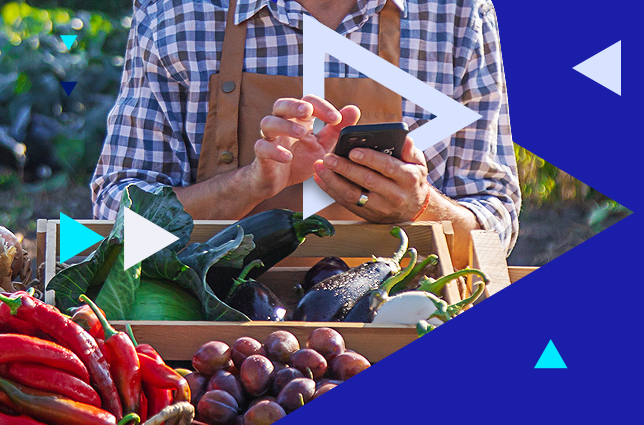
UNISOT provides a blockchain and AI-powered agricultural traceability platform built on the scalable BSV blockchain. The platform enables farmers to retain control over their data while creating verifiable Digital Product Passports aligned with regulatory and market demands.
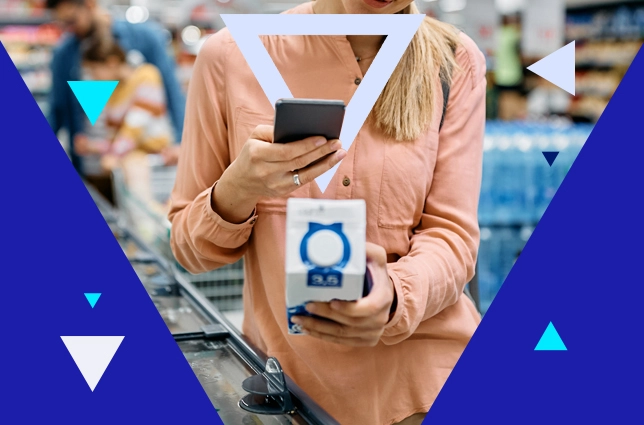
• QR codes or RFID tags connect each product or batch to its verified production history.
• Buyers and consumers can instantly access origin data, farming practices and certifications.
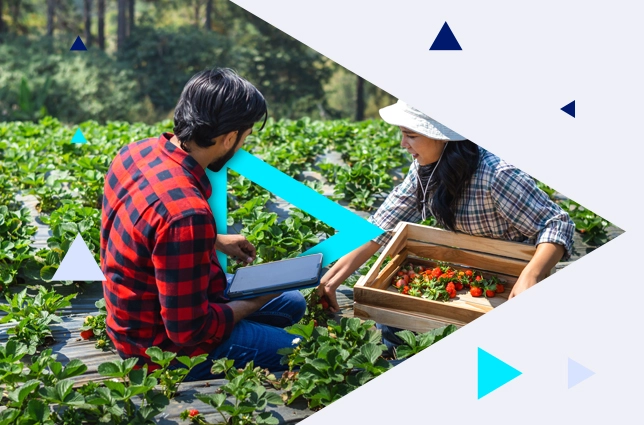
• Harvest data, inputs, certifications and production methods are recorded on-chain.
• Producers determine what information is shared, ensuring protection of commercially sensitive data.
• Water usage, energy consumption, waste and emissions are tracked using real operational data rather than estimates.
• Supports Scope 3 lifecycle reporting and ESG compliance across agricultural value chains.
• Organic status, animal welfare standards and food safety certifications are permanently recorded.
• Audit ready data reduces administrative burden and accelerates regulatory reporting.
• Consumers can independently verify product claims.
• Producers gain a trusted communication channel to demonstrate quality and sustainability credentials.
UNISOT demonstrates how public blockchain infrastructure can modernise agricultural operations while strengthening trust across supply chains.
Enhanced Market Access
Verified sustainability and compliance credentials unlock premium buyers and EU export opportunities.
Regulatory Readiness
Automated Digital Product Passports simplify alignment with evolving food safety and environmental frameworks.
Stronger Consumer Confidence
Transparent, blockchain-verified data supports credible organic, ethical and quality claims.
Operational Efficiency
Real-time, audit ready records replace manual compliance reporting processes.
Recognition of Sustainable Practices
Farmers receive measurable credit for responsible resource management and environmental stewardship.
As UNISOT states:
“Agriculture needs transparency that works across borders, companies and systems. A public blockchain gives farmers and consumers the same version of the truth.”
“With verifiable data from the field, sustainability reporting becomes factual instead of estimated.”
UNISOT illustrates how scalable public blockchain technology can empower agricultural producers to prove their value, meet regulatory obligations and build lasting relationships with global markets.
By anchoring verifiable data to a public blockchain, agriculture moves from trust-based claims to evidence-based accountability, establishing a new benchmark for transparency, compliance and sustainability in modern farming.

Blockchain is a distributed digital ledger that securely records transactions across multiple computers. This ensures transparency and prevents fraud. Once verified, data cannot be altered, making it ideal for sectors like finance, healthcare, and manufacturing. The BSV blockchain further builds on this by offering fast, scalable transactions while enabling smart contracts, secure transfers and immutable records – all with a low environmental footprint.
A blockchain works by storing data in blocks that are linked in a chronological chain. Once data is recorded, it cannot be altered without agreement from the rest of the network, ensuring security and trust.
Blockchain is the underlying technology, while Web3 builds on top of the blockchain to create decentralised applications (dApps) and enable user-owned internet experiences.
Non-fungible tokens (NFTs) are unique digital assets that represent ownership or proof of authenticity of a specific item on the blockchain. This can include anything from artwork to music to collectables. Unlike crypto assets, NFTs are not interchangeable because each one is distinct and cannot be replaced with another.
Web3 is a term used to describe the next version of the Internet, known as the Metanet, powered by blockchain. The Metanet enables a more efficient, transparent and monetisable data ecosystem than the current Web2 Internet.
Blockchain offers benefits like enhanced security, transparency, efficiency, and the elimination of third parties. It can be used for everything from financial transactions to supply chain management and voting systems.
A smart contract is a self-executing program on a blockchain which automatically enforces agreements when predefined conditions are met without needing third parties.
Digital assets are anything of value that exists in digital form, such as crypto assets, tokens, or digital records, which are stored and managed on a blockchain. Blockchain provides a secure, transparent, and distributed platform for creating, transferring, and verifying the ownership and integrity of these digital assets.
Decentralised applications (dApps) are applications that run on a blockchain rather than a centralised database. They typically operate using smart contracts, offering greater transparency, security, and user control while removing the need for third parties.
The risks for most blockchains include scalability challenges, high energy consumption, and the potential for hacking or exploitation in poorly designed smart contracts. However, the BSV blockchain is capable of massively scaling to handle millions of transactions per second, which means the CO2 produced per transaction is significantly lower than other competing blockchains.
Sign up to hear about news, events, and much more connected with BSV blockchain.
BSV Association is a Switzerland based non-profit organisation that serves as the global advocate for BSV blockchain. Its mission is to advance adoption and unlock the full potential of BSV as a scalable, secure, energy-efficient public blockchain built for data integrity, enterprise solutions, and government applications. The Association supports developers, enterprises, and public sector institutions by fostering innovation, encouraging regulatory compliance, and promoting real-world use cases that demonstrate blockchain’s value on a global scale. Through education, developer engagement, strategic partnerships, public policy initiatives, and technological advancement, BSV Association is committed to driving sustainable growth and long-term utility of blockchain technology.
© 2026 BSV Association org. All rights reserved